
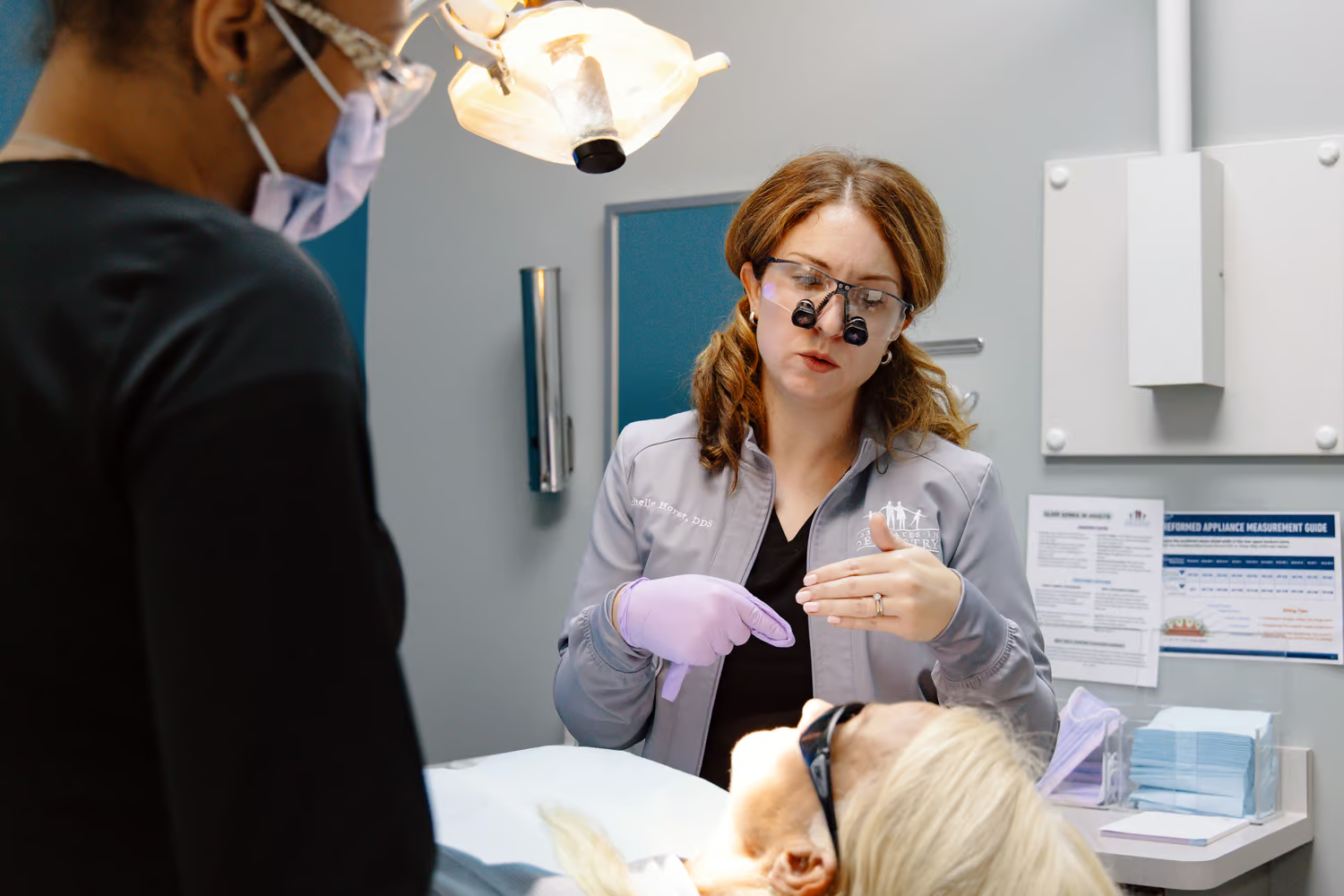



Dentist wearing loupes and an assistant treating a patient in a bright treatment room
Your family's dental home

Laser Gum Treatment in Peoria: A Gentler Way to Treat Gum Disease

Dentist wearing loupes and an assistant treating a patient in a bright treatment room
The short answer
Reviewed by our
Peoria
doctors.
Dr. Michelle Horst, dentist at Associates in Dentistry in Peoria
Dr. Arian Rrushaj, dentist at Associates in Dentistry in Peoria
Dr. Jonathan Gifford, dentist at Associates in Dentistry in Peoria and Washington

Gums that bleed when you brush or floss aren't normal, they're inflamed. Left alone, that inflammation works its way under the gumline and starts eating away at the bone holding your teeth in place. Catching it while it's still bleeding gums is a much simpler fix than catching it when a tooth wiggles.

01

Bleeding Gums and Loose Teeth Are Signs to Get Checked

Pink in the sink. That's how most folks first notice it. You spit after brushing and there's a little blood, and you figure you brushed too hard. So you brush softer. The bleeding keeps happening anyway.

Here's the thing we tell patients every week: healthy gums don't bleed. Not when you brush, not when you floss, not ever. Bleeding means bacteria have built up along the gumline and your body is fighting back. That fight is inflammation. And inflammation that sticks around long enough starts breaking down the bone underneath.

Bad breath that won't quit is another one. You brush, you rinse, you chew gum, and it's back by lunch. That smell usually comes from bacteria living in pockets below the gumline where a toothbrush can't reach. Tender or puffy gums, gums that look darker red than usual, gums pulling back so your teeth look longer than they did a few years ago - all of that points the same direction.

A tooth that feels slightly loose is the late sign. By then bone is already gone, and bone doesn't grow back on its own.

Not sure whether what you're seeing counts? That's common, and it's a fair question. Gum disease is sneaky because it rarely hurts until it's advanced. We measure pocket depths around every tooth at your exam and compare them over time. Numbers don't guess. If your pockets are getting deeper, we'll show you the chart and talk through what to do next. And if they're fine, we'll tell you that too.

02

You May Just Need a Cleaning, Not Laser Treatment

Here's the part most websites skip. A lot of people who see blood in the sink don't need a laser at all. They need a cleaning and better habits at home.

Bleeding gums usually mean inflammation. That's gingivitis. It sits above the gumline and it's reversible. Clean the plaque off, floss daily, come back in six months, and it often clears up on its own. No numbing. No laser. Nothing fancy.

The line between gingivitis and periodontal disease is bone loss, and we measure it with a small probe and x-rays.

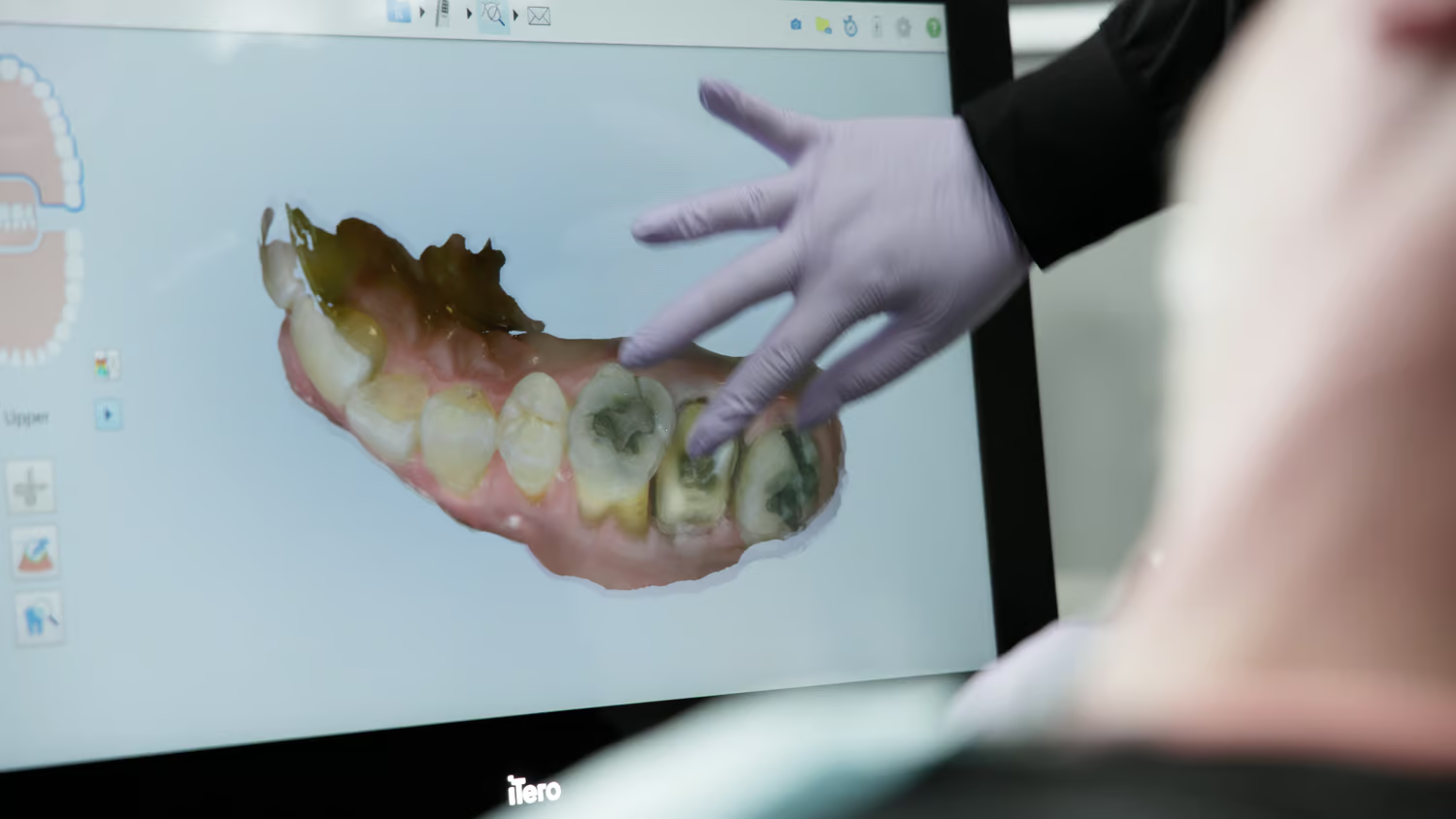
We check the space between your tooth and gum at six spots per tooth. One to three millimeters is healthy. Four and up means the pocket is deeper than a toothbrush can reach. That's when laser gum treatment starts to make sense. Below that number, a laser isn't solving anything you can't solve yourself with floss.

So when is waiting fine? If your gums bleed a little after you've skipped flossing for a few weeks, give it a month of consistent care first. Nine times out of ten the bleeding stops. If it doesn't, that's your answer - something deeper is going on.

  • Pockets of 1 to 3 mm with no bone loss: a regular dental cleaning is enough
  • Bleeding that stops after a few weeks of daily flossing: keep doing what you're doing
  • Pockets of 4 mm or deeper, or visible bone loss on x-ray: time to talk about laser gum treatment
  • Loose teeth, gum recession, or a bad taste that won't go away: don't wait on this one

We'd rather tell you your gums are fine than sell you something you don't need. That second-opinion x-ray review we do at our Peoria office exists for exactly this reason, it catches both over-treatment and things a single set of eyes might miss.

03

How a Laser Gum Treatment Appointment Works

Most people picture something dramatic, but it really isn't. A laser gum treatment visit looks a lot like a long cleaning appointment, just quieter and more focused. You sit back, we get the area numb, and the work happens a few millimeters at a time.

Here's how a typical visit runs:

  • We measure your gum pockets first and chart every tooth, so there's a real before number to compare against later.
  • We numb the area we're treating. You'll feel the pinch of the anesthetic and not much after that.
  • The laser fiber goes into the pocket and removes the diseased tissue lining it. No blade, no stitches.
  • We clean the root surface below the gumline to take off hardened tartar the laser can't reach.
  • The laser passes through one more time to seal the pocket against the tooth and control bleeding.
  • We go over home care, then set a recheck to measure those same pockets again.

We usually split the mouth into sections. Two visits is common, sometimes four if there's a lot of disease. Each appointment runs an hour to two hours depending on how much ground we're covering. And yes, you drive yourself home.

The rest of that day is the strange part. Your gums feel tender, not sharp. Soft food for a day or two. No brushing hard on the treated side. Some people go back to work that afternoon and forget they had anything done.

Wondering what your pocket numbers are? Most patients have never been told - ask at your next cleaning and we'll read them out loud to you.

Our Peoria office runs both a CO2 laser and a diode laser, and we pick based on what your tissue needs. The recheck matters as much as the treatment itself. If a pocket that was six millimeters is now three, we know it worked. If it didn't budge, we change the plan instead of repeating it.

Bleeding gums? Let's see if laser care fits.
04

Laser Treatment Versus Traditional Gum Surgery

The old way of treating deep gum pockets involves a scalpel. The gum tissue gets lifted back, the roots get cleaned, the infected tissue gets trimmed, and then everything is stitched closed. It works. Dentists have been doing it for decades and it still has a place. But you feel it afterward, and most people take a few days off their normal routine.

Laser gum treatment takes a different route to the same goal.

Instead of cutting the gum open, we slide a thin laser fiber into the pocket that already exists between your tooth and your gum. The laser targets diseased tissue and bacteria and leaves the healthy tissue alone. No scalpel. Usually no stitches. The tissue tends to seal as we work, so there's less bleeding during the appointment and less swelling after it.

Here's the honest part. Laser treatment isn't automatically better. It's better for certain mouths.

  • Moderate pockets that didn't fully close after a deep cleaning often respond well to the laser.
  • Patients on blood thinners or with bleeding concerns usually do better with less cutting.
  • People who can't take several recovery days off work tend to prefer the laser route.
  • Severe bone loss, loose teeth, or gum tissue that needs to be reshaped or grafted may still call for traditional surgery.
  • Some cases need both, laser first, then surgery on the two or three spots that didn't respond.

We measure your pockets, look at your x-rays, and tell you which category you fall into. Our Peoria office runs a second-opinion review on x-rays before we recommend anything surgical, so you're not getting one person's read on a borderline case. If the laser won't get you where you need to be, we'll say that. Selling you a gentler treatment that doesn't work isn't a favor - it just costs you another year of bone.

05

What Laser Gum Treatment Typically Costs

Let's talk money, because everybody's thinking about it anyway. Laser gum treatment isn't priced like a filling. It's almost never one flat number. Most offices quote it by how much of your mouth needs work, and that's measured in quadrants. Your mouth has four. Some people need one treated. Some need all four.

So when you hear a price, the first question is always the same: per quadrant, or for everything?

Here's what moves the number up or down.

  • Pocket depth. Deeper pockets mean more time under the laser and more visits.
  • How many quadrants are involved. One corner of your mouth costs far less than a full-mouth case.
  • Whether scaling and root planing is bundled in. Laser gum treatment usually works alongside deep cleaning, not instead of it.
  • Follow-up visits. Most cases need a re-measure a few months out, and sometimes a touch-up.
  • Whether any teeth are too far gone. If a tooth needs extraction or a bone graft, that's a separate line item.

Insurance is its own conversation. Gum disease treatment is often covered at some percentage, but coverage for the laser portion specifically varies a lot by plan. We accept and bill most insurance, though we're not in-network with any plan. That means we'll file for you and you'll see exactly what your plan pays.

Peoria's a price-conscious town. We know that. CareCredit and 0% interest payment plans up to six months are both available here, and nobody has to ask twice to hear the options.

Before you say yes to any quote, ask three things. What's included. What's not. And what happens if the pockets don't close the first time. A straight answer to that last one tells you a lot about the office you're sitting in.

FAQ

Answers to the most common questions.

Something else on your mind?
Call us at (309) 690-4500.

How do I know if I need laser gum treatment or just a cleaning?

The only way to know for sure is a gum measurement at your exam. We check the pocket depth around each tooth with a small probe. If pockets are shallow, 1 to 3 millimeters, a regular cleaning usually fixes things. Deeper pockets with bone loss on X-rays point to laser treatment instead. Bleeding alone doesn't tell the story. Most people who ask about laser treatment just need a good cleaning and better flossing.

Does laser gum treatment hurt?

Most people need only a little local numbing, and many need less than they expect. The laser targets infected tissue and leaves healthy gum alone, so there's less trauma than older methods. It also seals small blood vessels as it works, which keeps bleeding light. You may feel some tenderness for a few days afterward. Soft foods help during that time. Most patients tell us the visit was much easier than they braced for.

How long does recovery take after laser gum treatment?

Most people head back to work the next day. Your gums may feel tender for a few days, and treated spots can look a little white or gray as they heal, which is normal. How you feel depends on how deep your pockets were, how well you keep up with brushing and flossing, and whether you smoke. We schedule a follow-up visit to measure your pockets again and check how well things have tightened up.

What are the early signs of gum disease in Peoria patients?

Bleeding when you brush is usually the first sign patients in our Peoria office mention. Other clues include puffy or dark red gums, breath that returns an hour after brushing, and teeth that look longer because gums have pulled back. It rarely hurts at first, which is why people miss it. If bleeding shows up daily for a couple of weeks, it's worth getting your pockets measured rather than assuming it's your brushing technique.

Can gum disease be reversed without laser treatment?

Yes, early gingivitis can often be reversed with a dental cleaning and better flossing at home. At that stage, plaque is irritating the gum tissue, but the bone underneath hasn't been affected yet. Most people see their gums calm down within a few weeks of consistent care. Laser treatment becomes the better option once pockets get deeper and bacteria settle below where a toothbrush or regular cleaning can reach.

What equipment does your Peoria office use for laser gum treatment?

Our Peoria office keeps both a CO2 laser and a diode laser on hand, since they don't do the exact same job. We pick whichever fits your gums and the specific problem found during your exam. Having both means the same team that diagnoses your gum issue can usually treat it in the same visit, without sending you somewhere else. Your treatment plan is based on your pocket measurements, not a one-size-fits-all approach.

Request an appointment

Call us at (309) 690-4500

Tell Us About Yourself

Are you new to Associates in Dentistry?

Preferred Day and Time (optional)
Thank you! Your submission has been received!

That didn't go through. Please try again, or call your office.