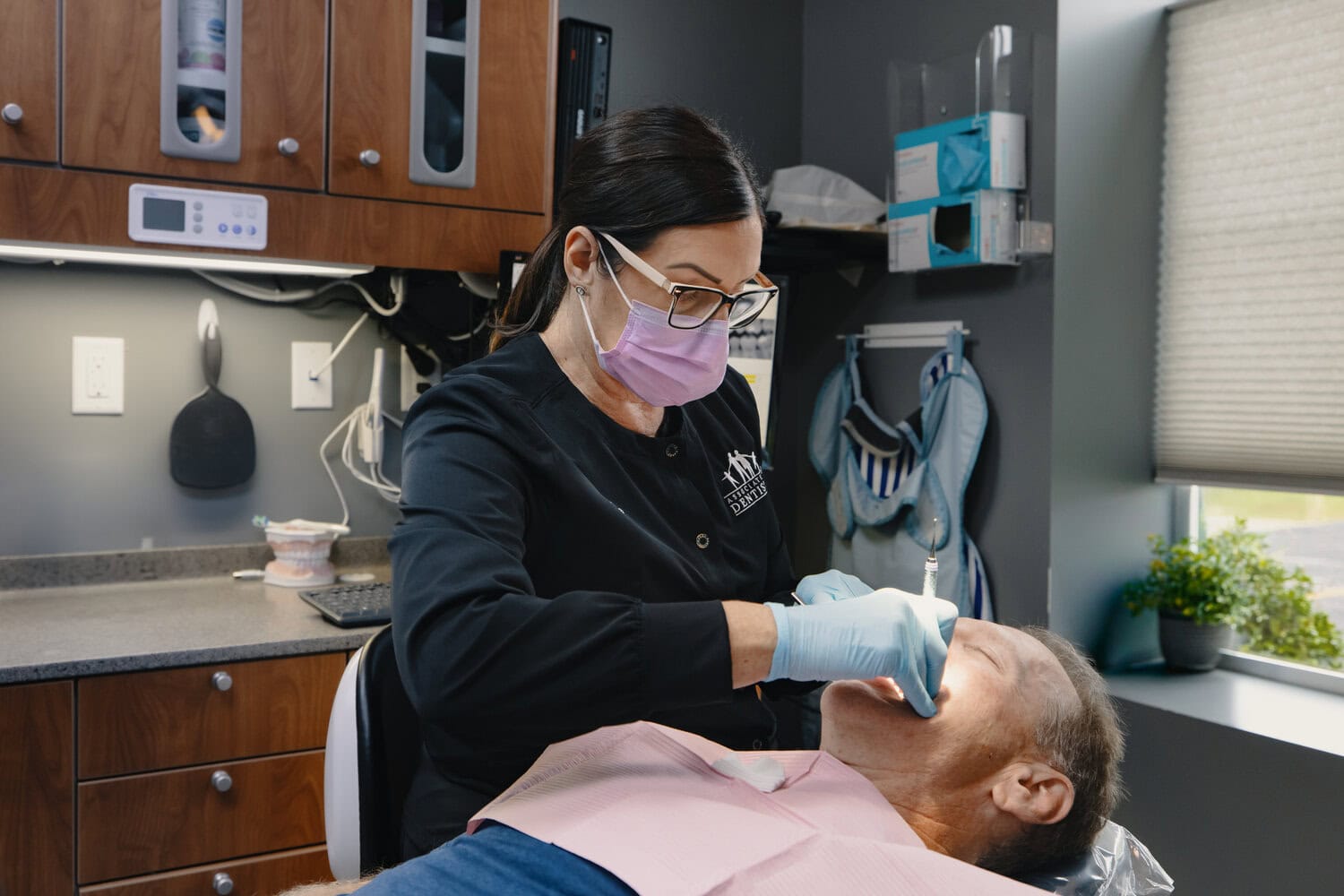


Hygienist in a mask cleaning a patient's teeth in a dental chair
Your family's dental home

Dental Cleaning in Washington

Hygienist in a mask cleaning a patient's teeth in a dental chair
The short answer
Reviewed by our
Washington
doctors.
Dr. Dennis Burton, dentist at Associates in Dentistry in Washington
Dr. Jonathan Gifford, dentist at Associates in Dentistry in Peoria and Washington

A routine cleaning removes plaque and tartar from your teeth and along the gumline. If your gums bleed, have pulled back or feel different, mention it during your visit. You may need more than a routine cleaning if gum disease is present.

01

What a Routine Dental Cleaning Includes

If you're looking for Dental Cleaning in Washington, the first question is whether a routine cleaning fits what you need right now. It's meant for regular care, not to solve tooth pain or every gum concern. Knowing that difference helps you ask for the right visit.

This is part of General Dentistry in Washington. Care is provided at our Washington office by Dr. Dennis Burton and Dr. Jonathan Gifford.

A routine cleaning focuses on buildup on your teeth. It's different from an exam, which checks your oral health, and it may not be the right care for a problem that needs treatment.

Think of a cleaning as care for the teeth you use every day. Brushing and flossing matter, but buildup can still collect, especially in spots that are hard to reach. A routine cleaning addresses that buildup. It doesn't repair a damaged tooth, explain the cause of pain, or tell you by itself whether your gums need treatment. Those are separate questions, even when they come up while you're thinking about a cleaning.

An exam is also separate from a cleaning. Associates in Dentistry offers both at our office, but you shouldn't have to guess whether you're asking for one or both. If your main goal is to keep up with regular care, say that when you contact us. If there's a tooth you want checked, mention it too. That gives us a clearer picture of what you're looking for without assuming a cleaning will answer a question that calls for an exam.

Your symptoms matter more than the name of the appointment. Bleeding gums, a sore spot, or a tooth that hurts may leave you wondering whether to book a cleaning. Don't leave those details out just because you'd also like your teeth cleaned. They may change what needs attention. Our office offers periodontal treatment and emergency dental pain treatment, which are distinct from a routine cleaning. Describing what you've noticed helps us understand the reason you're contacting us; it doesn't mean you've diagnosed the problem yourself.

It also helps to say when you last had a cleaning, if you remember, and whether anything has changed since then. You don't need a perfect dental history to have that conversation. Even a simple description, such as a spot that bleeds when you brush or a tooth that's become sensitive, is more useful than choosing an appointment name and hoping it covers everything. The point is to make sure your reason for coming in isn't lost behind the word “cleaning.”

02

How Often You Need a Cleaning

There's no single cleaning interval that fits everyone. The useful answer depends on how much buildup collects on your teeth and what a dentist finds when checking your gums. If you've already been given a schedule, use that as your starting point. If you don't know yours, ask at your next dental exam what interval makes sense for you and why.

It's easy to keep booking at the same interval because it's familiar. That habit may work well for you, but the date alone can't tell you whether it still fits. Two people who brush and floss every day can have different amounts of buildup by their next visit. You also can't always judge that buildup by how clean your teeth feel. That's why a recommendation based on your mouth is more useful than copying someone else's schedule.

If it's been longer than you meant to wait, you don't need to work out a new schedule before contacting us. Knowing roughly when your last cleaning took place is enough to start the conversation. You can then ask what interval to follow going forward. Our general dentistry in Washington includes dental cleanings, and that timing is worth discussing rather than choosing a date out of habit.

A good question at your next exam is, "What did you find that makes this interval right for me?" You can also ask whether anything at a future visit would change that recommendation. The answer gives you something more useful than a date to remember: a reason for the schedule. If you tend to lose track of appointments, write down the recommended interval when you get it. If your calendar changes, you'll still know what you were advised to plan for.

The goal isn't to book as often as possible or to stretch visits as far apart as you can. It's to have a plan that fits your teeth and gums. Once you know that plan, booking a cleaning becomes a simpler decision.

03

Signs You Need Periodontal Treatment Instead of a Routine Cleaning

If your gums have changed, don't assume a routine cleaning is all you need. Periodontal treatment addresses problems with the gums and the tissues that support your teeth. A cleaning and periodontal treatment serve different purposes, and what you can see at home won't always tell you which one fits.

Bleeding is one clue, especially if it keeps happening when you brush or floss. It doesn't, by itself, tell you that you have gum disease or need periodontal treatment. The same goes for gums that look red or swollen. What matters is that you've noticed a change worth mentioning, rather than quietly booking a cleaning and hoping it covers the concern.

Other changes can be less obvious. Your gums may seem to have pulled back, making a tooth look longer than it used to. A tooth may feel loose, or the way your teeth meet may seem different. Bad breath that doesn't seem to go away can also be part of the picture. None of these signs gives you a diagnosis on its own. Together, they tell a dentist more than the words “I need a cleaning” would.

You don't need to decide whether a problem is mild or serious before you reach out. Picture someone who hasn't had a cleaning in a while and now notices that one part of the gum looks lower than the other. The missed cleaning matters, but it doesn't explain the change. Asking only to catch up on cleanings could leave the question they care about unspoken: why does that tooth look different?

There isn't a simple at-home test for whether you need periodontal treatment. Gums can change gradually, and a tooth can feel fine even when you have a concern about the tissue around it. On the other hand, one unusual day of bleeding doesn't prove that routine care is no longer right for you. The point isn't to study every spot in the mirror. It's to describe a change you've noticed so the question can be assessed.

Associates in Dentistry offers periodontal treatment as well as dental cleanings at our office. If you're unsure which to ask about, say what's been happening and where you've noticed it. You don't have to use a treatment name. That leaves room to address your gum concern instead of assuming a routine cleaning is the answer.

Due for a cleaning? Let's get you scheduled.
04

How Billing and Insurance Work for a Cleaning Visit

Before you book a cleaning, it helps to know two things: what you’re asking to have done and how your plan handles it. Associates in Dentistry uses a fee-for-service model and accepts and bills most insurance plans. That doesn’t mean every plan covers a cleaning the same way, or that your share of the cost will be the same as someone else’s.

Start by checking whether your plan covers a routine cleaning, how often it covers one, and whether you’ve already used that benefit during the current plan period. A visit that falls outside your plan’s allowed frequency may leave you with a different amount to pay. If you’re not sure when your last cleaning was, tell us what you remember and ask your insurer what it has on record.

It’s also worth asking about an exam separately. You may want both, but they’re different services, and your plan may apply different rules to each. If you’re calling because of a tooth or gum concern, say so when you ask about costs. The care you need may differ from a routine cleaning. An insurance estimate based only on a cleaning might not answer the question you’re trying to settle.

Fee-for-service means the practice isn’t in-network with any plan. We’ll still file your claim, so ask what your plan is likely to pay and when your portion is due. Those are fair questions to ask before your visit. Give our office the name of your insurer and your plan details, then ask how billing works for that plan. You can also call the number on your insurance card to confirm your benefits directly.

If you don’t have dental insurance, ask what the cleaning would cost and whether an exam would have a separate charge. If you do have coverage, ask what portion you may owe rather than assuming that “covered” means no cost to you. An estimate is a planning tool, not a final bill: it depends on your plan’s terms and the services you receive.

For example, if you’re ready to get back on track after a long gap, you can say, “I’d like a cleaning, I’m not sure when my last one was, and I want to check the cost before I schedule.” Bring up any symptoms too. That gives you a better chance of getting answers about the visit you’re considering, instead of a general answer about cleanings that may not fit your situation.

05

What to Ask Before You Book

You don't need to know the right dental terms before you book. Start with why you're calling: you want a cleaning, and there's anything else on your mind. If a tooth hurts or your gums have changed, mention that at the start. The question is whether the appointment you're asking for matches the reason you want to come in.

Then ask about the parts of the visit that matter to your day. How much time should you set aside? Is an exam part of the appointment you're discussing, or would you need to ask for one separately? If you need to arrange a ride, time off work, or care for someone at home, those details are worth settling before you choose a time. Don't assume one appointment will cover everything you have in mind.

If you're new to this office, ask what information they'd like from you before the visit and whether records from a previous dentist would be useful.

If cleanings have been uncomfortable for you before, say what bothered you. Ask how you can raise a concern during the appointment rather than waiting until you're in the chair.

If you need help getting into the office or have another practical need, ask about it while scheduling so you can decide whether the visit will work for you.

You can be specific without having all the answers. “I've been putting off a cleaning because one spot is sensitive” gives us more to work with than “I need whatever's overdue.” So does “I'm not sure what happened at my last appointment.” Say what you remember and ask what else would help clarify your request. You won't have to name a treatment to describe a concern.

Before you finish the conversation, repeat back what you think you're booking. That can be as simple as, “So I'm asking for a cleaning, and I've mentioned the sensitive tooth. Is there anything else I should ask about before choosing a time?” It's a small check, but it gives you a chance to clear up a misunderstanding while you're still making plans.

Our office is at 300 Peoria St. If this is your first visit there, confirm the address when you book so you know where you're going. You can also ask what, if anything, you should bring. Getting those ordinary details straight makes it easier to focus on the reason you called.

Ready to set up a cleaning? Contact Associates in Dentistry in Washington, tell us what you'd like help with, and ask for an appointment that fits your needs.

FAQ

Answers to the most common questions.

Something else on your mind?
Call us at (309) 444-8481.

What happens during a dental cleaning?

A hygienist removes plaque and tartar that regular brushing and flossing cannot fully remove. Your dentist may also examine your teeth and gums during the visit.

How often should I have my teeth cleaned?

There isn't one schedule that fits everyone. Your dentist can recommend an interval based on your oral health, gum condition, and dental history.

Is a routine cleaning enough if my gums bleed?

Bleeding can have several causes. If your gums show signs of periodontal disease, you may need an evaluation and treatment beyond a routine cleaning.

Can I get a cleaning if it's been years since my last visit?

Yes. Tell the team how long it has been when you schedule. The visit can be used to assess your current oral health and determine what care you need next.

Does a cleaning replace a dental exam?

No. A cleaning removes plaque and tartar, while an exam gives the dentist a chance to look for decay, gum problems, and other concerns.

Request an appointment

Call us at (309) 444-8481

Tell Us About Yourself

Are you new to Associates in Dentistry?

Preferred Day and Time (optional)
Thank you! Your submission has been received!

That didn't go through. Please try again, or call your office.