
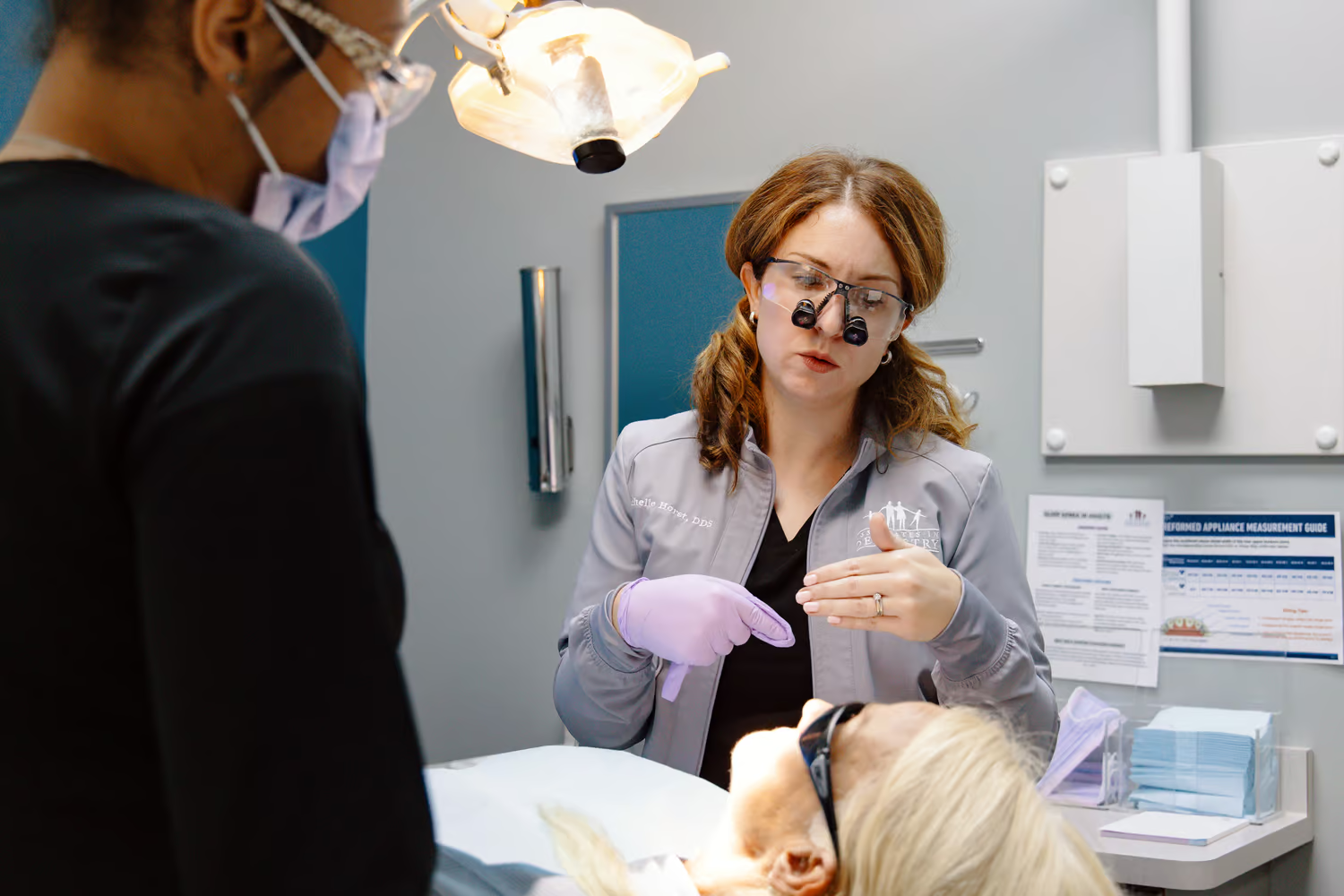


Dentist wearing loupes and an assistant treating a patient in a bright treatment room
Your family's dental home

Laser Gum Treatment in Bartonville: Healthier Gums Without Traditional Surgery

Dentist wearing loupes and an assistant treating a patient in a bright treatment room
The short answer
Reviewed by our
Bartonville
doctors.
Dr. Landall Cormier, dentist at Associates in Dentistry in Bartonville
Dr. Jessica Dean, dentist at Associates in Dentistry in Bartonville

A regular cleaning removes buildup above and just below the gumline. Once infection settles into deeper pockets around the root, brushing and a standard cleaning can't reach it. Bleeding, pulling gums, and persistent bad breath are the signs that the problem has moved past routine care.

01

Signs Your Gums Need More Than a Routine Cleaning

Most people don't feel gum disease early. That's the tricky part. There's no throbbing, no sharp pain, nothing that screams emergency. You just notice a little pink in the sink and figure you brushed too hard.

Healthy gums don't bleed. Not when you brush, not when you floss. So when they do, something's already going on under there.

Here's what we look for when someone tells us their cleanings never seem to hold:

  • Gums that bleed every time you floss, even the spots you're careful with
  • Bad breath that comes back within an hour of brushing
  • Teeth that look longer than they used to, or roots showing near the gumline
  • A tooth that feels slightly loose or shifts when you bite
  • Tenderness or puffiness in one specific area you keep avoiding

The measurement that settles it is pocket depth. We use a small probe to check the space between your gum and each tooth. Two or three millimeters is normal. At four, we start watching closely. Five and above means the pocket is deeper than any toothbrush bristle can reach, and that's the space where bacteria live undisturbed.

And this is exactly the point where a routine cleaning stops being the right tool. Not because it's a bad cleaning. Because the infection is somewhere the cleaning can't go.

We see this every week at our office. Someone comes in for a checkup, gets their numbers read out loud for the first time, and finally understands why their gums have bothered them for two years. Nine times out of ten they're relieved to have an answer.

Wondering if your bleeding gums are worth a look? Give us a call and we'll measure and tell you straight.

02

When You Do Not Need Laser Gum Treatment

Here's the part most websites skip. Plenty of people who ask us about laser gum treatment don't need it. Not yet, anyway. And we'd rather tell you that in the chair than take your money for something that won't change your outcome.

Bleeding when you brush is the most common reason folks call. But bleeding alone isn't a diagnosis. If your gums are puffy and red and the bone underneath is still solid, that's gingivitis. It's inflammation sitting on the surface. A regular dental cleaning plus better brushing at home clears most of those cases in a few weeks. No laser. No deep cleaning. We see this every single week, and it's always a good day when we get to say so.

Some other situations where the answer is wait, not treat:

  • Your pockets measure 3mm or less and there's no bone loss on the x-rays. Nothing to treat under the gumline.
  • You've never had a full periodontal charting done. We need the numbers before anyone picks a tool.
  • You're a heavy smoker who isn't ready to cut back. Gum tissue heals poorly with nicotine in the picture, and results won't hold.
  • The bone loss is so advanced the tooth is already loose and failing. At that point we're talking about extraction and replacement options, not saving what's left.
  • Your pain is coming from a cracked tooth or a dying nerve. That's a root canal conversation, and we handle those here in Bartonville.

There's also the honest middle ground. Sometimes we do a deep cleaning first, wait eight weeks, and re-measure. If the pockets closed up on their own, we stop. No reason to add a laser to a problem that already resolved.

The charting numbers make that call. Not a sales pitch, and not a guess.

03

How Laser Gum Treatment Works From Exam to Follow-Up

Most people picture something dramatic. It isn't. A laser gum treatment visit looks a lot like a long cleaning, just quieter and with less scraping.

Before anything else, we measure. Your hygienist uses a small probe to check the depth of the space between each tooth and the gum. Healthy pockets run about 1 to 3 millimeters. Anything deeper than that is holding bacteria you can't reach at home. We chart every number, take X-rays, and look at bone levels. Those numbers become the baseline we compare everything to later.

Here's the order of a typical case.

  • Exam and full pocket charting, tooth by tooth, with X-rays.
  • Numbing of the area we're treating, usually one side of the mouth at a time.
  • Scaling and root planing to clean the tooth roots below the gumline.
  • The laser passes into the pocket to remove diseased tissue and reduce bacteria.
  • A second laser pass to help the gum seal against the tooth.
  • Re-measurement at 6 to 12 weeks to see how the pockets responded.

We use a dental laser in-house at our office, so you're not being sent somewhere else mid-treatment. That matters more than it sounds. Splitting care between two offices is how follow-ups get missed.

Recovery is mild for most folks. Soreness for a day or two, some tenderness when you brush, and a soft-food suggestion for the first evening. No stitches. Bleeding is usually less than it is with traditional gum surgery.

The follow-up is the part people skip, and it's the part that tells us whether it worked.

We'll re-probe the same spots and compare them to your starting chart. If a 6 millimeter pocket is reading 3 or 4, the tissue reattached. If it hasn't moved, we talk about why. Sometimes it's a home care gap, sometimes it's grinding, sometimes a tooth needs a different plan entirely.

Bleeding gums? Let's see if laser care fits.
04

Recovery, Aftercare, and What Comes Next

Most people walk out and go back to their day. Your gums may feel tender, a little warm, maybe slightly swollen along the treated side. That usually settles within a day or two. Some folks notice their teeth feel more sensitive to cold for a couple of weeks while the gum tissue tightens back down against the root. That's normal, and it fades.

We see people brace for something much worse than what happens. No stitches. No scalpel line to baby. The blood clot that forms around the tooth is doing the healing work, so we ask you to leave it alone.

  • Stick to soft foods for the first day or two. Eggs, soup, pasta, yogurt.
  • Skip smoking. Nicotine shrinks blood flow to the gums and slows healing more than almost anything else you could do.
  • Brush gently around the treated area, but don't floss it until we tell you to.
  • Rinse with warm salt water a few times a day instead of using alcohol-based mouthwash.

Here's the part that matters more than the treatment day.

Gum disease is a bacterial problem, and bacteria come back. We'll usually want to see you again in about six to eight weeks to re-measure those pockets and see how much they closed. After that, most patients move to a cleaning schedule every three or four months instead of every six. That's not upselling, it's the window before the bacteria rebuild to the level that caused the bone loss in the first place. Skip those visits and the pockets deepen again, often within a year.

So the honest answer is this. The laser gives you a clean starting point. What you do over the next few years decides whether you keep it.

05

How Laser Gum Treatment Is Priced and What Affects Cost

Nobody wants to ask the money question first. But you're thinking it, so let's get to it. Laser gum treatment isn't priced as one flat item. It's priced by how much of your mouth needs work and how deep the problem goes.

Most offices in this field quote by quadrant. Your mouth has four of them. If gum disease shows up in one back corner only, that's one quadrant. If it's spread across your whole mouth, that's four, and the fee reflects that. Pocket depth matters too. A 5mm pocket takes less chair time than an 8mm pocket with bone loss underneath.

Here's what moves the number up or down:

  • How many quadrants need treatment, not how many teeth hurt
  • Pocket depth and whether bone has already been lost
  • Whether deep cleaning is needed before the laser step
  • How many follow-up visits it takes to get pockets stable
  • Whether you need ongoing maintenance cleanings afterward

Insurance is its own conversation. Dental plans often cover part of periodontal treatment, but coverage for the laser portion varies a lot plan to plan. Some cover it under the same code as traditional therapy, some don't. We bill most insurance plans, though we aren't in-network with any of them, so we'll walk you through what your plan says before you commit to anything.

And if the number lands heavier than you expected, say so. CareCredit and 0% interest payment plans up to six months are both available here. We'd rather split it up than have you put it off.

One more thing worth knowing. Waiting almost always costs more. Gum disease doesn't hold still, and treating four quadrants with bone loss is a bigger job than treating one pocket caught early.

FAQ

Answers to the most common questions.

Something else on your mind?
Call us at (309) 697-2228.

How do I know if I need laser gum treatment or just a regular cleaning?

You need laser gum treatment when pocket depths measure 5 millimeters or more, not just when your gums bleed. Bleeding alone often means gingivitis, which a normal cleaning and better brushing can clear up. We measure every tooth with a small probe before recommending anything. If your pockets are 3 millimeters or less with no bone loss, a cleaning is all you need right now.

What happens during a laser gum treatment visit?

A laser gum treatment visit starts with numbing, then scaling and root planing to clean below the gumline. After that, the laser passes into each pocket to remove diseased tissue and reduce bacteria, followed by a second pass to help the gum reseal against the tooth. It feels like a longer, quieter cleaning with less scraping. Most people are surprised how routine the whole appointment feels.

How long does recovery take after laser gum treatment?

Most people feel back to normal within a day or two. Your gums may feel tender, warm, or slightly swollen along the treated side that first evening. We suggest soft foods that night and gentle brushing near the area for a few days. There are no stitches involved, and bleeding is usually much lighter than what people expect from traditional gum surgery.

How soon can I tell if the treatment worked?

We re-measure your pocket depths at 6 to 12 weeks to see the real answer. If a pocket that read 6 millimeters now measures 3 or 4, the tissue reattached and healed the way we hoped. If the number hasn't moved, we look at home care habits, grinding, or whether a different plan is needed. The follow-up chart tells us the truth, not a guess.

Can smoking affect how well laser gum treatment works?

Yes, smoking can keep gum tissue from healing properly after treatment. Nicotine slows blood flow to the gums, which makes it harder for pockets to close even after the laser does its job. If you're a heavy smoker who isn't ready to cut back, we'll talk about timing before moving forward. We'd rather wait for better results than treat too soon.

Do I need a full gum exam before scheduling laser treatment at your office?

Yes, a full periodontal charting comes first, every time. We measure pocket depths at every tooth and take X-rays to check bone levels before recommending laser treatment. Those numbers become the baseline we compare against later. Skipping this step means picking a treatment before we know what's happening under your gums, which isn't how we practice at our office.

Request an appointment

Call us at (309) 697-2228

Tell Us About Yourself

Are you new to Associates in Dentistry?

Preferred Day and Time (optional)
Thank you! Your submission has been received!

That didn't go through. Please try again, or call your office.