
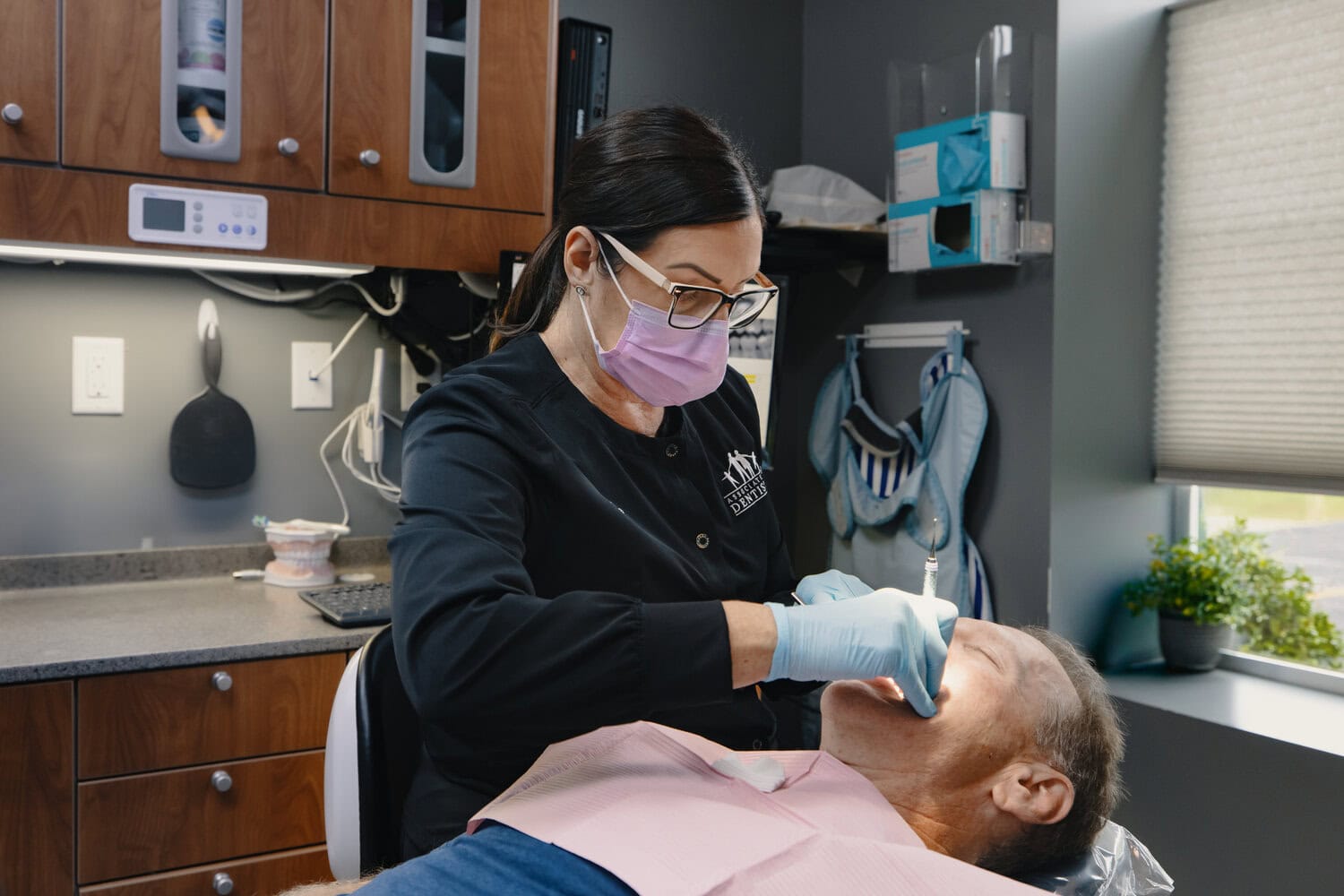


Hygienist in a mask cleaning a patient's teeth in a dental chair
Your family's dental home

Dental Cleaning in Bartonville: What a Routine Visit Involves

Hygienist in a mask cleaning a patient's teeth in a dental chair
The short answer
Reviewed by our
Bartonville
doctors.
Dr. Landall Cormier, dentist at Associates in Dentistry in Bartonville
Dr. Jessica Dean, dentist at Associates in Dentistry in Bartonville

A routine dental cleaning usually takes about 45 minutes to an hour. It includes an exam and x-rays as needed, scaling to remove plaque and hardened tartar, polishing, flossing, and a look at your gums with a small measuring probe. The cleaning part is quick. The checking part is what protects you.

01

What a Routine Dental Cleaning Includes

Most people picture the polish and nothing else. But the polish is the last five minutes.

This is part of General Dentistry in Bartonville. Care is provided at our Bartonville office by Dr. Landall Cormier and Dr. Jessica Dean.

Here's how a visit runs at our office. You sit down, and we start by looking. X-rays if you're due for them, because decay between teeth doesn't show up any other way. Then a hygienist checks your gums with a thin probe that measures the little pocket where the gum meets the tooth. Healthy is one to three millimeters. Deeper than that and we're watching something.

  • Exam and x-rays as needed, plus a look at your tongue, cheeks, and the roof of your mouth
  • Gum pocket measurements, recorded so we can compare them next time
  • Scaling, where we lift plaque and hardened tartar off the tooth and just under the gumline
  • Polishing with a gritty paste to smooth the surface
  • Flossing between every tooth, then a rinse
  • A few minutes with the dentist to go over anything we found

Scaling is the part people ask about. We use hand instruments, an ultrasonic scaler, or both. The ultrasonic one vibrates and sprays water, it sounds louder than it feels. Tartar is hardened plaque, and once it sets, brushing won't move it. That's the whole reason this appointment exists.

If your gums bleed a little, don't be embarrassed. We see it every single week, and it's information, not a scolding.

The dentist step at the end matters more than folks realize. That's where a small chip, a worn spot from grinding, or an early cavity gets caught while it's still small and cheap to fix. Dr. Cormier and Dr. Dean see patients here, and either one may be the one sitting down with you to go through what we found.


02

Cleaning Versus Deep Cleaning: Knowing Which One You Need

Here's the question we get more than almost any other. Someone comes in expecting a routine visit and hears the words "deep cleaning," and their guard goes right up. Fair enough. So let's be plain about what separates the two.

A regular dental cleaning works above the gumline and just barely below it. Your gums are snug against the teeth, the pockets measure one to three millimeters, and the hygienist can reach everything. A deep cleaning, called scaling and root planing, goes under the gumline to clean the root surfaces. That's only needed when the gums have pulled away and tartar has settled down in those pockets where a brush can't go.

The measurement is what decides it. Not a hunch.

During your exam we probe around each tooth and record the depths. Four millimeters with bleeding starts the conversation. Five and six, with bone loss showing on the x-ray, and a routine cleaning won't fix the problem. Polishing the tops of teeth while infection sits three millimeters below does nobody any good.

But here's the other side, and we'll say it even though it costs us. Plenty of people come in convinced they need a deep cleaning because they skipped a few years. Heavy tartar, bleeding when they floss, breath that bothers them. And the numbers come back fine. In those cases you need a regular cleaning, maybe a longer appointment, and then you need to come back in a few months so we can see how the gums respond. That's it. Bleeding gums alone don't mean gum disease, they often mean the gums are irritated and out of practice.

If someone quotes you a deep cleaning without showing you pocket depths and x-rays, ask for them. You're allowed to. Our dentists here in Bartonville will walk you through the chart tooth by tooth, and if the answer is a regular cleaning, that's what you'll get.

03

When You Can Wait and When You Should Call

If your last visit was six or seven months ago, your gums don't bleed when you brush, and nothing hurts, you're fine to schedule at your convenience. Stretch it to eight months if life got busy. That's normal. We'd rather you come in a little late than skip the year entirely because you felt guilty about it. Same goes if you just had a baby, just moved, or just started a new job. Book when you can breathe.

Waiting also makes sense in one other spot. If you're mid-treatment somewhere else, finish that first, then get your cleaning. Doubling up rarely helps anything.

But some things shouldn't sit. Bleeding is the big one. Gums that bleed every single time you brush aren't sensitive, they're inflamed, and inflammation left alone turns into bone loss you can't undo. That's the whole argument of this page in one sentence: the visit is cheap compared to what it prevents.

  • Gums that bleed daily, or look puffy and dark red instead of pink
  • Breath that comes back within an hour of brushing
  • A tooth that's gotten loose, or feels like it shifted
  • Gums pulling back so a tooth looks longer than it did
  • Any pain that wakes you up or lingers past a few days

One more real-world note. Fall and early winter fill up fast around here, partly because folks in Bartonville and the surrounding Peoria County towns use up insurance benefits before they reset January 1. If you're aiming for December, call in October. Nine times out of ten the people who wait until Thanksgiving end up in February, and that's a longer gap than they wanted.

Due for a cleaning? Let's get you scheduled.
04

What Happens If the Hygienist Finds a Problem

The hygienist stops, sets something down, and says she wants the dentist to take a look. That pause can feel heavier than it really is. Most of the time it's a small spot on an X-ray or a gum pocket that measured a millimeter deeper than last visit.

So what happens? Your hygienist finishes charting what she found. Then Dr. Cormier or Dr. Dean comes in, looks at the same images, and checks the tooth directly. You see the picture on the screen. Nobody talks about treatment until you've seen what they're seeing.

Nine times out of ten it's one of a short list.

  • A small cavity between two back teeth that flossing can't reach
  • Gum pockets deeper than three millimeters, usually along the lower front teeth
  • A hairline crack in an old filling that's been there fifteen years
  • Wear on the biting surfaces from grinding at night
  • A tooth that's tender to tapping but looks fine on the surface

Each one has a different clock on it. A tiny cavity can wait a few months, deep gum pockets usually shouldn't. We'll tell you which is which, plainly, and we'll tell you if the honest answer is watch it and recheck in six months.

The office has an in-house mill, so a lot of follow-up work doesn't mean a second office across town. Same-day crowns get milled here. We do root canals in-house. That matters when you're already taking time off work.

And if you need time to think about it, take it. We'll write it down, hand you the plan, and it'll still be in your chart when you're ready. No one here is going to call you about it on a Tuesday night.

05

How Dental Cleaning Costs and Insurance Billing Typically Work

Let's talk money, because most people are thinking about it and nobody asks. A dental cleaning isn't one flat price across the board. It's billed by procedure code, and the code depends on what your gums need that day.

A routine cleaning above the gumline is one code. A deeper cleaning that goes below the gumline, done by section of the mouth, is a different code and usually more than one visit. That's the single biggest thing that moves the number. Not the office. Not the day of the week. Your gum health.

  • How much buildup is present and how long it's been there
  • Whether pocket depths call for a routine cleaning or deeper treatment
  • Whether x-rays and an exam are done at the same visit
  • How many visits the deeper work takes to finish
  • How often your plan allows cleanings in a calendar year

Here's where our practice sits, plainly. We moved to a fee-for-service model in August 2024. We accept and bill most insurance, Medicaid excluded, but we're not in-network with any plan. That means we file the claim for you, your plan pays what it pays, and the difference is yours. Some patients get back nearly everything. Some get back less than they expected. The honest answer is it depends on your specific plan.

And if the number is awkward, say so out loud. We offer CareCredit and 0% interest payment plans up to six months.

Before you book anywhere, ask three questions. What code will this be billed under? Is this office in-network with my plan? And if I need deeper treatment, how many visits is that? Any front desk worth trusting will answer all three without hedging, we do it every day.

FAQ

Answers to the most common questions.

Something else on your mind?
Call us at (309) 697-2228.

How long does a routine dental cleaning take?

A routine dental cleaning usually takes 45 minutes to an hour. That covers an exam, x-rays if you're due, gum pocket measurements, scaling to remove plaque and tartar, polishing, and flossing. The cleaning itself is quick. The checking part, where we measure your gums and look for early problems, is what protects your teeth long term. At our office, you'll also spend a few minutes with the dentist going over anything we found.

How do I know if I need a regular cleaning or a deep cleaning?

The gum pocket measurement decides it, not a hunch. Healthy pockets measure one to three millimeters and get a regular cleaning. Four millimeters with bleeding starts the conversation, and five or six millimeters with bone loss on the x-ray means you need scaling and root planing. Bleeding gums alone don't automatically mean you need a deep cleaning. If someone recommends one without showing you pocket depths and x-rays, ask to see them.

Why do my gums bleed during a cleaning?

Bleeding gums usually mean irritation, not necessarily gum disease. We see this every single week, and it's information for us, not something to be embarrassed about. Gums that are out of practice from irregular brushing or flossing often bleed at first. But if your gums bleed every time you brush at home, that's inflammation that can turn into bone loss over time, so it's worth mentioning at your next visit.

How often should I get a dental cleaning?

Most people do fine scheduling every six to seven months, and stretching to eight months if life gets busy is normal too. If your gums don't bleed and nothing hurts, you're fine waiting a bit for convenience. But daily bleeding, puffy or dark red gums, a loose tooth, or pain that lingers past a few days means you shouldn't wait. Call the office sooner if any of those show up.

Why is fall such a busy time for dental cleanings in Bartonville?

Fall and early winter fill up fast because folks in Bartonville and nearby Peoria County towns use up insurance benefits before they reset on January 1. If you're aiming for a December appointment, call in October. People who wait until Thanksgiving to book often end up pushed to February instead, which is a longer gap than they planned for.

What happens if the hygienist finds a problem during my cleaning?

The hygienist pauses and asks the dentist to take a look at anything unusual, like a small chip, a worn spot from grinding, or an early cavity. This catches problems while they're still small and easier to treat. Either Dr. Cormier or Dr. Dean may sit down with you afterward to explain what was found and what your options are, so nothing feels like a surprise.

Request an appointment

Call us at (309) 697-2228

Tell Us About Yourself

Are you new to Associates in Dentistry?

Preferred Day and Time (optional)
Thank you! Your submission has been received!

That didn't go through. Please try again, or call your office.
